Links
Member profile


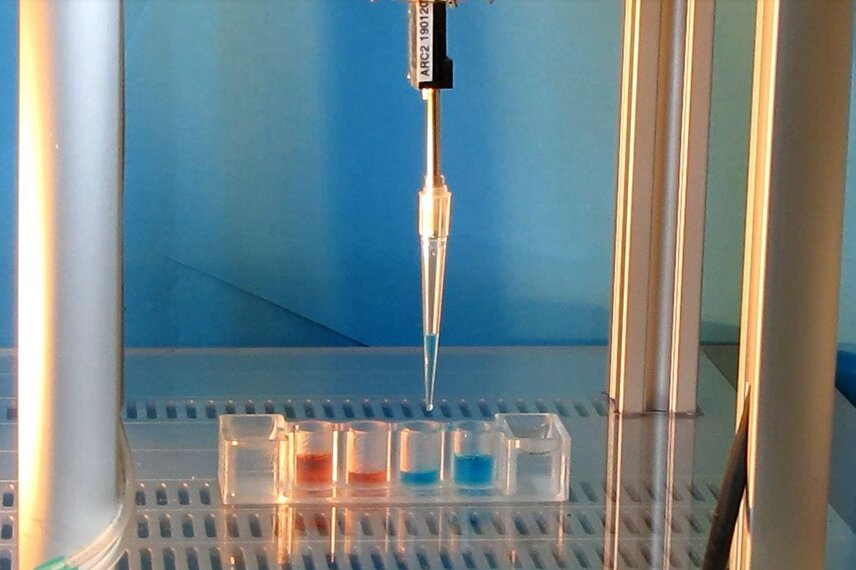
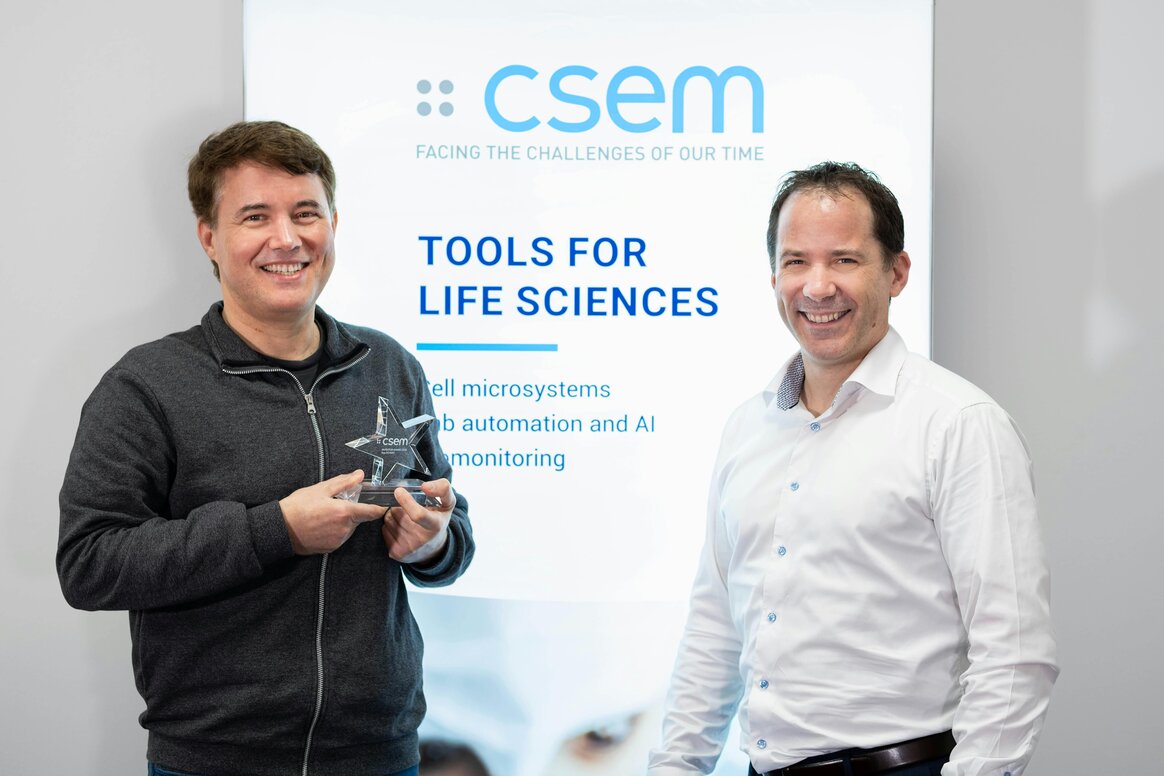
Micro-mechanical engineer Noa Schmid has been awarded the CSEM Inventor Award 2026 for his work in high-precision liquid handling. His developments focus on technologies for the exact dosing, control, and measurement of extremely small liquid volumes in automated laboratory environments.
Over more than two decades, Schmid has worked on optimizing systems for microliter and sub-microliter dosing. Such technologies are essential for biochemical analyses, including in vitro diagnostics, drug development, environmental analysis, and the monitoring of biological parameters. Key technical challenges include precise volume control, reproducible flow profiles, and the minimization of dead volumes and contamination risks.
During his tenure at CSEM, eight patents were generated in the field of liquid handling. A central focus of his work has been the miniaturization of components and systems while maintaining or improving precision. Shorter fluidic paths reduce reaction times and lower the consumption of costly reagents. At the same time, scaling systems down to the microscale requires high mechanical stability, precise actuation, and reliable sensor integration.
In cooperation with the Swiss company Tecan, a pipetting platform was developed that covers an exceptionally wide volume range, from milliliters down to the microliter scale. Its technical implementation required scalable dosing mechanisms and accurate calibration across different volume ranges.
Together with the French company Fluigent, Schmid contributed to the development of a system for measuring extremely small liquid flow rates. The sensor used operates without direct contact with the liquid, reducing the risk of contamination and making it particularly suitable for sensitive biological or chemical applications.
In collaboration with Hamilton, he developed a component for the automated verification of dosing accuracy in liquid-handling systems. Such testing units are relevant for quality-critical laboratory processes, as they enable continuous validation of system performance.
He also designed a pulsation-free micropump. Conventional pump systems often generate pressure and flow fluctuations that can interfere with sensitive analytical procedures. The developed solution ensures a stable, uniform flow rate and was used, among other applications, in a flow cytometer aboard the International Space Station (ISS) to analyze blood samples under microgravity conditions.
A patent filed in 2022 further forms the basis for a compact home diagnostic system developed by the Swiss start-up Testmate Health. The device analyzes urine samples for several sexually transmitted infections and relies on miniaturized, automated liquid handling within a closed system.
Schmid’s work highlights the importance of integrated micromechanical systems for modern laboratory automation. Crucial factors include the precise interaction of actuation, fluidics, sensor technology, and control electronics, as well as the industrial scalability of the developed solutions. The award recognizes in particular the successful transfer of microengineering innovations into market-ready applications in the life sciences sector.
.jpg)
An innovative system to perform routine accuracy testing of automated liquid handling systems has been developed at CSEM in collaboration …
.jpg)
As of August 1, 2025, Bartels Mikrotechnik proudly welcomes Florian Siemenroth as Co-Managing Director. Together with Monika Kremer, he will …
Dr. Matthias Jahncke is the new Managing Director of HNP Mikrosysteme GmbH. He takes over from Dr. Thomas Weisener, who …

.jpg)